Category: News

  • A Trump U.S. Attorney’s Professional Misconduct Must Be Kept “Private and Confidential”

    A Trump U.S. Attorney’s Professional Misconduct Must Be Kept “Private and Confidential”

    An ethics watchdog found that a Trump administration-appointed former U.S. attorney committed professional misconduct in response to allegations that included retaliating against a newspaper for negative coverage. But details about John Sarcone’s case have been deemed “private and confidential” — and aren’t being released to the public.

    Read more FBI Quietly Closed a Probe Into Mahmoud Khalil While He Was in ICE Detention

    One of New York state’s grievance committees, disciplinary panels that determines penalties for violations of legal ethics, notified nonprofit groups last week of its finding against Sarcone, Donald Trump’s on-again, off-again U.S. attorney in Albany.

    The committee is keeping mum on the exact nature of its findings, and in a letter to a press freedom group last week, it even tried to claim that the foundation could not disclose the very fact that it found “there was sufficient basis for a finding of professional misconduct.”

    The letter from the Attorney Grievance Committee for the Appellate Division, Third Department, was dated April 1 and sent via email on May 8. The committee did not immediately respond to a request for comment on when the finding was reached.

    The committee’s actions fit in a larger pattern of New York shrouding prosecutorial misconduct investigations in secret. One of the groups that filed a complaint, the Freedom of the Press Foundation, said it was time for the state’s legal ethics cops to stop insisting on silence.

    “Sarcone is a high-ranking prosecutor who is at the center of national news as we speak and who the New York Grievance Committee found had engaged in professional misconduct after he retaliated against a news outlet,” said Seth Stern, chief of advocacy at the foundation. “No complainant, but especially a press freedom organization, should be told to keep quiet about something so plainly newsworthy and important to New Yorkers and Americans.”

    Sarcone and the Justice Department did not immediately respond to requests for comment.

    In an emailed statement, the grievance committee said it was following state laws. Under that law, chief committee attorney Monica Duffy said, “until such time as charges of professional misconduct are sustained against an attorney in a public order of the New York State Supreme Court, Appellate Division, all papers, documents and records concerning this Committee’s investigation and disposition of any grievance complaint concerning the conduct of that attorney are sealed and deemed private and confidential.”

    Sarcone had no prosecutorial experience when the Trump administration tapped him to lead the U.S. Attorney’s Office for the Northern District of New York last year. Since then, he has been involved in a long-running saga over whether he can even run the office.

    Sarcone has never been confirmed by the U.S. Senate. After his temporary appointment to the post expired, judges appointed a veteran prosecutor to fill the post. That replacement was fired within hours. Sarcone has continued to oversee the office as state Attorney General Letitia James and Justice Department lawyers argue in court over whether he lawfully holds the office.

    The administration has a major incentive to keep the Trump loyalist in charge: The Albany prosecutor’s office has jurisdiction over New York state politicians who have drawn the president’s ire, including James.

    Read more Maine Dems to Vote on Condemning DCCC Interference in House Primary

    In addition to the question of whether he can hold the office, Sarcone has faced criticism for booting the Albany newspaper off his office’s press list after it reported that he had attempted to claim a boarded-up apartment building in the district as his home to satisfy residency requirements.

    That action was a violation of the First Amendment, the Freedom of the Press Foundation argued in the August 11 complaint it filed with the grievance committee, along with Reinvent Albany and the Demand Progress Education Fund. The complaint alleged that Sarcone may have violated at least four of the state’s rules of professional conduct.

    In the response to the complaint sent last week, the committee said that “after deliberation, the Committee determined there was a sufficient basis for a finding of professional misconduct and took appropriate action.”

    The case was now closed, the committee said. In the letter dated April 1, the committee said that it had reached its conclusion at a “recent” meeting.

    What “appropriate action” the committee took is unclear. There are no records of public discipline in Sarcone’s entry on the state attorney directory. The committee has a range of actions it can take short of public discipline, including private letters of reprimand.

    Another group that filed a similar complaint against Sarcone, Campaign for Accountability, received a near-identical letter from the grievance committee. In a statement, that group noted that Sarcone remains in charge of the U.S. attorney’s office with a title of first assistant.

    “While we’re pleased the New York Attorney Grievance Committee recognized that Mr. Sarcone, who remains First Assistant in the U.S. Attorney’s Office, engaged in professional misconduct, a secret slap on the wrist is insufficient. Mr. Sarcone’s pattern of conduct reflects on his credibility as an officer of the court, so any court in which he appears — along with the public — deserves to know what he was sanctioned for and why,” said Campaign for Accountability’s executive director, Michelle Kuppersmith.

    The letters to both complainants including a heading indicating that they were “confidential.” Stern said that attempting to force people who filed complaints to remain silent about the letters they receive in response would be unconstitutional.

    One state grievance committee previously tried to clamp down on law professors who shared details about the complaints they had filed against local prosecutors accused of failing to turn over exculpatory evidence or lying in court. The professors sued and won a federal district court ruling in their favor.

    Read more Hasan Piker Is the Democrats’ New Man on the Trail, Whether They Like It or Not

  • FBI Quietly Closed a Probe Into Mahmoud Khalil While He Was in ICE Detention

    FBI Quietly Closed a Probe Into Mahmoud Khalil While He Was in ICE Detention

    A recently released FBI file shines new light on the days immediately leading up to the arrest of then-Columbia University student and Palestinian rights activist Mahmoud Khalil.

    Read more Maine Dems to Vote on Condemning DCCC Interference in House Primary

    On March 6 of last year, two days before unidentified officers from Immigration and Customs Enforcement abducted and arrested Khalil at his home, the FBI received an anonymous tip claiming that Khalil, listed incorrectly as a 22-year-old, had called for “violence on behalf of Hamas.” 

    According to the heavily redacted documents, as of March 19, 2025, the FBI had closed an investigation into the tip and determined that Khalil “does not warrant further FBI investigation.” But by then, ICE had already secretly taken Khalil, now 31, thousands of miles away to a detention center in Louisiana. Despite the FBI’s decision to close the tip, the Trump administration continued to paint Khalil as a “Hamas supporter” and a threat to national security. 

    It’s unclear if the FBI tip was directly related to Khalil’s ICE arrest, and the FBI did not respond to The Intercept’s question about whether the tip was shared with ICE. But Hamid Bendaas, a spokesperson at the Institute for Middle East Understanding, which has worked with Khalil since his arrest, said the timing reflects “a threat to us all.”

    Though the FBI document says Khalil did not warrant further investigation, “that didn’t stop ICE from holding him in a detention center and separating him from his wife and newborn son for months,” Bendaas said. 

    The document comes to light as the Trump administration has fast-tracked Khalil’s deportation case, which Khalil’s legal team argues is a form of retaliation against his protected political speech in support of Palestine. Khalil’s team received the FBI document, which has not been previously reported, via a lawsuit over a public records request and shared it exclusively with The Intercept.

    Khalil was the first of thousands of students the Trump administration targeted for deportation over First Amendment-protected speech in support of Palestine or criticizing Israel. The Trump administration exploited an obscure provision in immigration law to claim that Khalil and other students, including Mohsen Mahdawi and Rümeysa Öztürk, presented a threat to U.S. foreign policy interests. Secretary of State Marco Rubio, who ordered Khalil to be deported, has repeatedly claimed that he sympathized with terrorists, echoing claims from far-right doxing groups that had targeted Khalil in the months leading up to his arrest. Trump’s unprecedented crackdown came after years of similar attacks on pro-Palestine students that gained speed under former President Joe Biden. 

    “Under Trump’s rogue presidency being led by extremists and conspiracy theorists,” Bendaas said, “any of us can be kidnapped by federal agents in the middle of the night simply for speaking against U.S. support for Israel’s genocide, no matter what the facts or Constitution says.” 

    Read more Hasan Piker Is the Democrats’ New Man on the Trail, Whether They Like It or Not

    The Center for Constitutional Rights, part of Khalil’s legal team, submitted a request for public documents related to his arrest nearly a year ago, on May 29, 2025. After denials and delays, CCR filed a on November 20 claiming that federal agencies, including the FBI, had improperly withheld the records. CCR said it has since received other documents from the Department of Justice and is expecting more from other agencies in the coming months.

    “Despite the FBI closing its investigation with no findings to support the accusation, the Trump administration continued to label Mr. Khalil a supporter of Hamas in public comments,” said CCR staff attorney Samah Sisay. “This document further supports our argument that the Trump administration had no legitimate reason to target Mr. Khalil besides his free speech in support of Palestine.”

    In a statement to The Intercept, an FBI spokesperson said, “We let documents obtained through the FOIA process speak for themselves and decline to comment further.”

    Reacting to the FBI file, an attorney at Palestine Legal condemned the Trump administration’s approach but called it “representative of the tactics used more broadly against Palestine activists.”

    “Revelations that false reports were made against Mahmoud prior to his government sanctioned kidnapping, and that the administration continued to make false claims that Mahmoud posed a danger, even though the FBI found these claims to be unsubstantiated, are highly representative of this administration’s broader approach of acting first and making up justifications later, with no regard for truth or the findings of the administration’s own experts,” said Zoha Khalili, a senior managing attorney at Palestine Legal. “Around the world, people who demand freedom, equality, liberation, and the basic necessities of life for Palestinians have been smeared, silenced, investigated, and even imprisoned for their advocacy.”

    Khalil’s team also plans to appeal the Board of Immigration Appeals order rejecting Khalil’s appeal to terminate his deportation proceedings. He is still fighting a separate federal habeas corpus case and cannot be deported while the case proceeds.

    Update: May 12, 2026, 4:06 p.m. ET
    This story has been updated with a comment from an attorney at Palestine Legal sent after publication.

    Read more Tennessee GOP Moves to Decimate Black Voting Power After Supreme Court’s Blessing of Jim Crow

  • Maine Dems to Vote on Condemning DCCC Interference in House Primary

    Maine Dems to Vote on Condemning DCCC Interference in House Primary

    Locals in Maine are bridling at the decision by a powerful Washington Democratic group to throw its weight behind one candidate in the contested primary race for the House seat in the state’s 2nd Congressional District.

    Read more Hasan Piker Is the Democrats’ New Man on the Trail, Whether They Like It or Not

    On Monday, the Democratic Congressional Campaign Committee issued a coveted endorsement of state Sen. Joe Baldacci in the primary race, prompting angry protests from the three other candidates in the race to replace outgoing Democratic Rep. Jared Golden.

    In response to the endorsement, the Penobscot County Democratic Committee — in Baldacci’s home county, which includes the city of Bangor — will vote Saturday on a measure to condemn the endorsement. The language of the proposal, which was put forward by former Maine state Senate President Charles Pray, denounces the endorsement as being in “total disregard and willfully ignoring” local party rules that bar the Democratic state and county chapters from backing a candidate in a primary.

    “With the DCCC deciding to throw itself into the mix here, truthfully that just kind of aggravated me,” Pray told The Intercept. “I’m going to support whoever wins the Democratic nomination, but I just think it was an unfair position on their part of trying to dictate or trying to boost up a candidate. Point is, let the people decide. Let the voters in the primary make that determination.”

    Pray, who previously worked in the Clinton and Obama administrations and described himself as “a progressive moderate with liberal tendencies but conservative perspectives,” has personally backed State Auditor Matt Dunlap in the race, but said his pique at the DCCC’s endorsement isn’t about any one candidate.

    “This has nothing to do with Joe — I think all four of them have an equal chance,” Pray said. “It’s a primary, and, by the way, our state party rules and our county rules are that the party organization cannot endorse or support a candidate.”

    A spokesperson for the DCCC said the group was focused on winning in the general elections and beating back President Donald Trump’s agenda.

    “It’s imperative that Democrats must take back the House to hold Trump accountable and deliver on what truly matters to voters,” said the spokesperson, Viet Shelton. “That’s why we are proud to announce our latest round of Red to Blue candidates who span the ideological spectrum, are authentic voices in their districts, and are best positioned to win in November.”

    Four-Way Race

    The race to replace Golden — who announced in November that he would not seek reelection — is being closely watched nationwide ahead of the midterm elections. Whoever takes the Democratic primary will square off against Paul LePage, a brash, plainspoken businessman and Republican former governor whose time running Maine was marked by proto-MAGA far-right populism.

    Baldacci is facing off against Dunlap, who is also a former Maine secretary of state; Jordan Wood, a longtime Democratic fundraiser and political operative; and Paige Loud, a social worker and first-time candidate. In the wake of the DCCC endorsement of Baldacci, the other candidates in the race took aim at D.C. Democrats for picking a side.

    Read more Tennessee GOP Moves to Decimate Black Voting Power After Supreme Court’s Blessing of Jim Crow

    “It’s undemocratic for national establishment Democrats to put their thumb on the scale in any primary,” Dunlap said. “Just like in certain other races across Maine this year, they won’t decide this one — the people of Maine will.”

    With Dunlap picking up endorsements from Our Revolution, Rep. Ro Khanna, D-Calif., and other progressives, Baldacci — who enjoys name recognition as the brother of former Gov. John Baldacci — is widely seen as the establishment candidate in the race. Reached by phone Thursday, Baldacci declined to comment on the Penobscot County party proposal condemning the endorsement, but said he was glad to have the backing of Democrats in Washington.

    “I’m pleased that they did it,” Baldacci said, referring to the endorsement. “My understanding is they based it on polling to determine who is the best candidate to run against LePage.”

    Wood said the DCCC move demonstrated the problems with Washington party politics.

    “The fact that the national Democratic Party would come in and try to decide this primary literally weeks before we vote is just another example of how broken our Democratic leadership is,” he said.

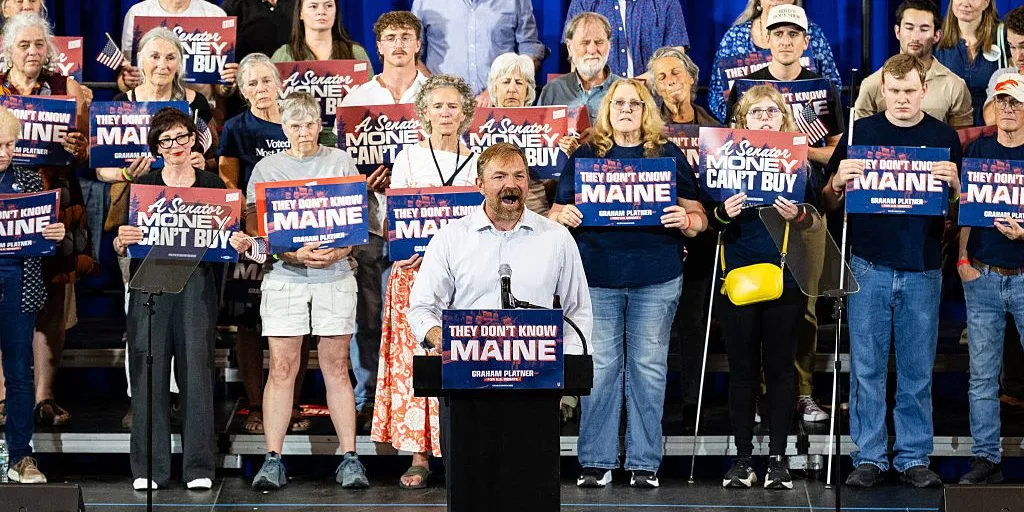
    A Pan Atlantic Omnibus poll in March put Baldacci well ahead of his opponents, but there is little in the way of recent polling to indicate a current popular favorite in the race. Following the stunning collapse of Gov. Janet Mills’s bid for the U.S. Senate — despite the backing of the Democratic Senatorial Campaign Committee — against populist insurgent Graham Platner, not everyone in Maine sees the DCCC as the best political oracle to follow.

    “It’s annoying that the DCCC thinks they know better than Mainers,” said Loud, the left-leaning social worker. “We just saw the DSCC’s endorsement of Janet Mills, and we all saw how that turned out. I don’t think they have the finger on the pulse.”

    Update: May 7, 2026, 5:12 p.m. ET
    This story has been updated to include Jordan Wood’s experience as a political operative.

    Read more These Middle Eastern News Sites Are Actually U.S. Government Propaganda Operations

  • Hasan Piker Is the Democrats’ New Man on the Trail, Whether They Like It or Not

    Hasan Piker Is the Democrats’ New Man on the Trail, Whether They Like It or Not

    Devin Thomas O’Shea is the author ofThe Veiled Prophet: Secret Societies, White Supremacy, and the Struggle for St. Louis,” publishing with Haymarket Books in June 2026.

    Read more Tennessee GOP Moves to Decimate Black Voting Power After Supreme Court’s Blessing of Jim Crow

    In a letter to Twitch and Amazon, New York Democratic Rep. Richie Torres once slammed Hasan Piker, the popular political streamer, for his “depravity” and called him “the poster child for the post-October 7th outbreak of antisemitism.” While mainstream Democrats and their allies have for months weighed the “problem” of Piker for the party, his star has only continued to rise. Insurgent candidates on the left are now making him their go-to surrogate, with Piker as a new kind of kingmaker, one they hope can shepherd his mass of online supporters behind them.

    Piker recently touched down in Missouri to lend his star power to Cori Bush, who is looking to reclaim her position in the House after serving as the first Black woman to represent the state’s 1st Congressional District from 2021 to 2025. During her first term in office, Bush authored a bill calling for an “immediate deescalation and cease-fire in Israel and occupied Palestine.” In what was widely read as retribution, Bush was primaried by a Democratic opponent, Wesley Bell, who ended his own Senate campaign against Republican Josh Hawley for the run; Bell defeated Bush with the help of an unprecedented nearly $9 million in spending from the super PAC for the American Israel Public Affairs Committee, or AIPAC.

    Now Bush is back, and like Piker, is unbowed: During the rally, she wore a T-shirt with her campaign slogan “FIGHT BACK” in big, bold letters. 

    “I love seeing you all,” Bush told the May Day crowd. “I just don’t love why I keep seeing you all.”

    Bush, who rose to prominence as an activist with the Black Lives Matter movement, quickly gained a reputation in office for bucking establishment Democrats — even outpacing other members of “the Squad” — and being outspoken in her criticism of party leadership.

    On his wildly popular Twitch stream, Piker has argued that “80 percent of the Democratic Party now agrees with the principles that Cori Bush was defending at a time when it was inopportune for her to do so.” Piker’s visit to St. Louis coincided with weeks of national media scrutiny condemning the popular streamer’s views as antisemitic, culminating in Reps. Mike Lawler, R-N.Y., and Josh Gottheimer, D-N.J., pushing a bipartisan bill to explicitly denounce Piker.

    But for the left, the criticism rings more like an endorsement, and Piker has hit the campaign trail for a number of progressive Democrats including Abdul El-Sayed, who’s running for the Senate in Michigan; Dr. Adam Hamawy, who’s running for a New Jersey House seat; and Rep. Ilhan Omar, who’s up for reelection in Minnesota. 

    On stage with Bush, Piker described Bell as an “AIPAC stooge,” and urged St. Louisans to rally around the Bush campaign. “Republicans are monsters who traffic in hatred,” said Piker. “But we’re no longer going to vote for do-nothing Democrats, either.” He told the crowd about a St. Louis woman at the airport who was shocked to see him, visiting the city. “There’s this attitude in places like Missouri where city slickers like myself, the bicoastal elite, don’t come to places like St. Louis. Like, she genuinely was shocked,” Piker said on a stream re-cap.

    At the rally, Piker described St. Louis as part of a growing coalition of the discontented. “I’ve seen a lot of places like St. Louis. Places that have been left behind by wealthy corporations that pollute your waters and steal your productive output … but today we say, ‘No more!’”

    In a statement to The Intercept, a spokesperson for Bell pointed to common criticisms from mainstream figures over Piker’s past online comments. “If Cori Bush spent as much time meeting with her constituents as she does associating with people who condone sexual assault and blame America for September 11th, she may have fared better in her last election,” said Bell campaign spokesperson Jordan Blase.

    Before Piker and Bush, historian Ángel Flores Fontánez took the stage as an organizer with the Party for Socialism and Liberation, anchoring the day in proud St. Louis labor history. One of the first American general strikes took place in the city in July 1877, when railroad workers across the United States objected to immiseration imposed by Gilded Age robber barons.

    In 1877, railroad workers across the United States shut down rail line capital from New York to Pennsylvania, Pennsylvania to Ohio, all the way out west to Missouri. In St. Louis, the strike escalated, evolving into a general action which drew river levee roustabouts, coopers, newsboys, foundry workers, and refinery laborers into a weeklong action. 

    The strike was a multiracial coalition, and the strike’s executive committee briefly ran St. Louis as one of the first commune governments before it was violently suppressed.

    Fontánez recalled the city’s legacy of socialists, which dates back to the abolitionist German ’48ers, and the Funsten Nut Strike of May 1933. As University of Missouri history professor Keona Ervin notes in “Gateway to Equality: Black Women and the Struggle for Economic Justice in St. Louis,” the Funsten strike was one of the first successful strike actions of the era, with the Communist Party USA using the strike as a moment to “mark the urban Midwest as a new hotbed for radical labor politics spearheaded by black working women.”

    In the aftermath of the 2014 Black Lives Matter movement, which began in the St. Louis suburb of Ferguson, many hoped to see St. Louis once again become a beacon of progressivism. But Missouri poses a cadre of challenges: The 1st District is a gerrymandered product of a red state that used to be purple. Missouri was a bellwether for a century, but as polarization intensified in the early 2000s, Missouri Republicans successfully drew maps that neutralized the state’s urban progressive centers.

    Most Missourians live in the blue islands of St. Louis, Kansas City, and Springfield, which also make up 80 percent of the state’s annual GDP. Previously, the state elected Democratic governors, senators, and controlled a handful of congressional seats. But now the 1st District is one of the few remaining positions not controlled by Republicans.

    Decades of state and federal Republican rule have been disastrous for the Greater St. Louis area, plunging the city into a pattern of capital flight and population loss. The city is still reeling from the May 2025 tornado which ripped through the city and hit historically Black neighborhoods in North St. Louis the hardest.

    From the Federal Emergency Management Agency to the St. Louis mayor’s office, many residents feel the recovery has been botched and worry that the North Side will not be rebuilt. Last month, protesters confronted Mayor Cara Spencer over the sluggish cleanup effort, where houses have been left half-destroyed and their residents sleeping in tents. 

    Read more These Middle Eastern News Sites Are Actually U.S. Government Propaganda Operations

    “When we’re going to our electeds, we’re saying fully fund the North Side,” Bush told the crowd. “If you can’t stand up to Donald Trump and his administration — at the city level, the state level, or the federal level — then you’re no representative for us. If you can’t stand up to Donald Trump and his allies, then how are you supposed to stand up for us?”

    St. Louisans are calling on their elected officials to fight for more disaster relief, and also against attacks by the state legislature. At the direct request of President Donald Trump, Missouri Gov. Mike Kehoe, a former car dealership owner turned Republican politician, is attempting to further gerrymander the voting map for Kansas City. 

    Kehoe also wants to abolish Missouri’s income tax, which critics say will send the state into a budget tailspin not unlike Sam Brownback’s failed tax-cutting policy, the “Kansas Experiment.”

    The governor also caused an uproar by legally invading St. Louis in 2025, taking over state control of the city’s police department. In doing so, Kehoe defied a 2012 statewide vote which granted local control of the police to the St. Louis mayor. Missouri is the only state in the U.S. where the governor controls the police of the major cities, including the police budget.

    Many St. Louisans are vehemently opposed to the police takeover and disgruntled with the status quo, but Missouri’s 1st District includes several neighborhoods in St. Louis County that went heavily for Bell in 2024. G Gamache, a union organizer with Starbucks Workers United who attended May Day rally, told The Intercept that Bush is still the fighter St. Louis needs.

    “When you see her in person, you see how much she hasn’t changed who she is. … She’s still 10 toes down on things like Medicare for All, affordable housing, and ending the genocide of Palestinians by Israel. A wide majority of Democratic voters, and even many Republican voters, even in Missouri, support all these things,” he said.

    Back in August 2025, Bush’s opponent, Wesley Bell, held his first and only in-person town hall, which was disrupted by protesters. Local activists challenged the congressman on his support of Israel, his refusal to call Gaza a genocide, and his trip to Tel Aviv, which was sponsored by the American Israel Education Foundation.

    During the town hall, a man providing security for Bell was caught on video attempting to forcefully physically remove the protesters. 

    Between Missouri Republicans and Bell, the 2.8 million St. Louisans living in the greater metropolitan area are generally represented by pro-Israel politicians. According to the Pew Research Center, most U.S. voters have soured on Israel, which is now engaged in an invasion of Lebanon, continued violence in the West Bank, the further annihilation of Gaza, and now an ongoing conflict with Iran, which has shut down the Strait of Hormuz, a critical shipping lane. As of April 2026, 60 percent of U.S. adults have an unfavorable view of Israel, up from 53 percent last year, and the trend seems to be accelerating.

    Bell has tried to square this circle by recognizing the Armenian genocide, voting against Trump’s Big Beautiful Bill, and denouncing Kehoe’s attempts to redraw Missouri’s congressional maps. Since the initial almost $9 million, AIPAC has continued supporting Bell, directing donors through its PAC’s portal to fund his campaign.

    Blase, the Bell spokesperson, told The Intercept that “Congressman Bell remains focused on standing up to Trump and fighting for the people of Missouri’s first Congressional District.”

    While Bush called for a ceasefire early on, her criticisms of Israel don’t quite explain why AIPAC would spend so much on a Missouri congressional campaign.

    A more complete answer may lie in Missouri as a node in the country’s military–industrial complex. St. Louis is home to several Boeing facilities, with the Seattle-headquartered aerospace company selling a range of weapons to the Israeli military, including F-35 and F-15IA fighter jets, missiles, and smart bombs.

    In 2020, pro-Palestine student groups in St. Louis protested the St. Charles Boeing facility over a $2.2 billion contract to manufacture small-diameter bombs sold to foreign nations, including Israel, and in 2024, the Washington University Student Union Senate passed a resolution to divest from Boeing.

    In one of its corporate PR products, a 2025 Boeing video highlighted St. Louis as “Fighterland U.S.A.,” nicknamed for its importance in military jet manufacturing across the Lambert International Airport and Scott Air Force Base complexes. In February 2026, the company announced the return of its Defense, Space & Security headquarters to St. Louis. Missouri’s Whiteman Air Force Base in Knob Noster, near Kansas City, made headlines in June 2025 as playing a key role in launching strikes against Iran.

    St. Louis is also home to a number of companies on pro-Palestine boycott lists. The North American headquarters of Israeli Chemical Limited Group — which manufactures fertilizers, metals, and chemical products including white phosphorus — is in Creve Coeur, Missouri. As Human Rights Watch reported, Israel used white phosphorus in populated areas of Gaza and Lebanon in October and November 2023.

    Bush told The Intercept that Missouri voters are agitated enough to show up and oust Bell, pointing to polling that shows the race to be neck and neck. But Bush is positioning herself as a fighter for people who have long felt left behind by the Democratic Party.

    “If you hurt my people, I can’t sit back and do nothing. … If we wait on the feckless people in some of these seats to do it, it’ll never happen,” she promised.

    Read more Pentagon Erases Wounded U.S. Troops From Iran War Casualty List: “Definition of a Cover-up”

  • Tennessee GOP Moves to Decimate Black Voting Power After Supreme Court’s Blessing of Jim Crow

    Tennessee GOP Moves to Decimate Black Voting Power After Supreme Court’s Blessing of Jim Crow

    The ink had barely dried on the Supreme Court’s ruling to gut the Voting Rights Act when Republican lawmakers raced to deliver on the barely veiled promises of the court’s decision: the decimation of Black political power and a revival of Jim Crow-era racist voter suppression.

    Read more These Middle Eastern News Sites Are Actually U.S. Government Propaganda Operations

    In Tennessee on Thursday, Gov. Lee signed a bill that repealed a half-century-old law prohibiting mid-decade redistricting, and then the overwhelmingly Republican legislature passed new redistricting maps that eliminate the state’s only Black-majority district. The 9th Congressional District, also Tennessee’s only reliable Democratic seat, will be carved into three — purposefully redrawn for each piece to have a white-majority and Republican-leaning electorate. The votes of Memphis’s 63 percent Black population will be diluted to near irrelevance; the entire state will be handed to Republicans.

    No one can act surprised. This was the predicted outcome of the Supreme Court’s Louisiana v. Callais decision, which decimated Section 2 of the embattled Voting Rights Act, a provision that had protected minority voters from redistricting. With the right-wing justices’ blessing, Republican lawmakers can now enact segregationist gerrymandering and reestablish the pre-civil-rights-era status quo ante.

    It stands to reason that Republicans are not representing the interests of Black Tennesseans, some 17 percent of the population, overwhelmingly Democrats. These residents only have one representative in Washington, Rep. Steve Cohen — the lone Democrat among the state’s nine congressional seats. That is the seat being eliminated by the new maps passed by Tennessee’s largely white legislature.

    The situation is already one in which Black working-class interests are hardly represented — and nor would greater Black representation in the state necessarily ensure the delivery of racial justice and the economic justice it requires.

    The point is that Black disenfranchisement both reflects and produces conditions of white supremacist rule, wherein greater anti-Black oppression is assured.

    “These maps are racist tools of white supremacy, at the behest of the most powerful white supremacist in the United States of America, Donald J. Trump,” said Democratic state Rep. Justin Pearson at the Tennessee statehouse on Thursday. Pearson, a progressive activist and one of the state’s few Black representatives, is running for a seat in Congress and was neck and neck in polling for his August primary against Cohen, the 76-year-old incumbent. The redrawn maps would likely foreclose his chance to represent South Memphis in Washington.

    Pearson called the gerrymandered maps a “political lynching” that “set our state back over 150 years.”

    Trump’s Larger Project

    Trump, who is historically unpopular, has every reason to push his GOP to use newly unconstrained gerrymandering capacities in advance of the midterms. Right-wing redistricting efforts go beyond a scramble for November, though, and sit within a larger project of white supremacist backlash.

    Like in Tennessee, Republicans in Alabama, Louisiana, Mississippi, and South Carolina all called special legislative sessions — as explicitly ordered by Trump — to push new redistricting maps that will decimate majority-Black districts and deliver congressional seats to Republicans.

    According to the cynical rationale of the Supreme Court conservatives, such maps would not violate what’s left of the Voting Rights Act, because the GOP is not openly describing their gerrymander as targeting Black voters.

    “The more racist you are as a party, the more insulated you are from Voting Rights Act liability under this decision,” Justin Levitt, a professor at Loyola Law School, told Bolts Magazine about the Callais ruling. “If there were a party called the Klan party, right now, it would trigger an awful lot of nonwhite opposition based on the party’s platform. But this opinion says, you have to set the party’s platform entirely aside to figure out if there’s been any damage based on race. So the more you can tie the two together, the more insulated you are.”

    In short, as Levitt put it, “the most racist partisan gerrymandering is going to be the most immune from a VRA challenge.”

    Read more Pentagon Erases Wounded U.S. Troops From Iran War Casualty List: “Definition of a Cover-up”

    Tennessee Republicans proved precisely this point on Thursday. Striding into the statehouse to disenfranchise Black voters, Republican state Rep. Todd Warner wore a giant Trump 2024 flag as a cape.

    As other states follow Tennessee’s example, the consequences of Callais could see the largest-ever drop in the number of Black lawmakers in Congress. The previous record was set, NPR reported, in the post-Reconstruction backlash, by the Congress that began in 1877 with four fewer House districts represented by Black lawmakers than the previous session.

    In response to racist Republican gerrymandering, Democrats can play their own game of redistricting — but there’s a reason the Callais decision is understood as a gift to Republicans.

    “The states controlled by Republicans where there are majority-minority districts have no internal constraint on how much they can screw over Black voters, because Black voters are not voting for that party,” Pamela Karlan, law professor at Stanford University and co-director of Stanford’s Supreme Court Litigation Clinic, told Slate.

    Democrats could expand a small number of safe seats in New York and California, for example, by eliminating minority voter districts. As Karlan noted, however, this would be politically unpalatable because “the politics of the state are not going to look favorably on that, and the Democrats in those states depend on Black and Latino voters in statewide races.”

    According to Karlan, in this race to the bottom, Republican-led election fixing will not be addressed without a different Congress, a different president, and a powerful political movement to hold politicians accountable.

    “Voters have to first build a political movement around this that makes elected officials afraid to do this,” she said.

    Meanwhile, Democratic redistricting efforts in Virginia were dealt a blow on Friday, when they were struck down by the state’s Supreme Court. Voters had approved in a referendum to redraw the state’s congressional map, but the court’s ruling hands Republicans a fierce electoral advantage.

    After Thursday’s vote, Tennessee Democratic state Rep. Justin Jones burned a paper Confederate flag in the statehouse rotunda, surrounded by protesters who had gathered to decry the racist gerrymandering.

    “We saw a time like this, in this building before,” Jones told his fellow lawmakers earlier this week during the unprecedented redistricting special session. “If you study Reconstruction. We had Black lawmakers after the Civil War, then from the end of the 1800s to the 1960s, we had no Black folks here” — meaning the statehouse.

    On Thursday afternoon, the NAACP’s Tennessee chapter filed a lawsuit challenging the legality of the new congressional map, which is likely to be the first of several legal efforts against the rushed, conniving, and unrepentantly racist gerrymander.

    Read more Hegseth Clings to Phony Ceasefire to Help Trump Evade War Powers Pressure

  • These Middle Eastern News Sites Are Actually U.S. Government Propaganda Operations

    These Middle Eastern News Sites Are Actually U.S. Government Propaganda Operations

    Al-Fassel and Pishtaz News look like typical news websites. They have neatly designed homepages and active social media accounts, where they share reporting and videos on Middle Eastern geopolitics in Arabic and Farsi, respectively, as well as English. Al-Fassel’s X account states the publication’s mission is “to investigate events of great significance that are often overlooked by local and regional media, and to shed light on them.” The Pishtaz News X account says it was established “to investigate and expand upon important news that local and regional media often overlook.”

    Read more Pentagon Erases Wounded U.S. Troops From Iran War Casualty List: “Definition of a Cover-up”

    These overlooked stories share the same ideological slant and editorial voice: that of the White House. Al-Fassel’s YouTube account, for instance, has racked up millions of views on Arabic-language videos praising the Trump administration’s Gaza policy and exhorting Hamas to cease “taking orders from the Iranian regime” and release Israeli prisoners. On Pishtaz News, a poll on the homepage recently asked: “[H]ow would you describe your belief about the Supreme Leader’s current health status and whereabouts?” Possible answers range from “In good health but hiding” to “Disfigured” or “Dead.” The excellence of Saudi and Emirati leadership, both close military partners of the U.S., is a recurring theme.

    There’s a reason this coverage echoes American foreign policy talking points. Al-Fassel and Pishtaz News are, in fact, part of network of websites and social media accounts purporting to be legitimate Middle Eastern news outlets that are in fact propaganda mills funded by the United States government, The Intercept has found.

    Disclosed only at the bottom of both sites behind an “About” link that is easily missed by casual readers, the outlets note that they are “a product of an international media organization publicly funded from the budget of the United States Government.” The government affiliation remains undisclosed on social media platforms including Instagram, despite a platform policy requiring the labeling of state-backed media outlet to prevent the unwitting consumption of government propaganda.

    The sites’ recent fixation on crushing Iran is unlikely to be a coincidence: Both publications share numerous connections with a portfolio of fake newsrooms that originated as a military psychological operations campaign against foreign internet users.

    Al-Fassel and Pishtaz News did not respond to requests for comment, nor did CENTCOM or the Department of Defense.

    In 2008, U.S. Special Operations Command put out a call for contractors to help operate what it called the Trans-Regional Web Initiative, a project that would provide “rapid, on-order global dissemination of web-based influence products and tools in support of strategic and long-term U.S. Government goals and objectives.” In other words, state propaganda pushed by Pentagon.

    Masquerading as independent online newsrooms, the TRWI sites hired “indigenous content stringers” to produce articles “which Combatant Commands (COCOMs) can use as necessary in support of the Global War on Terror.” The contract, awarded to General Dynamics Information Technology, spawned 10 websites that funneled U.S. foreign policy talking points to audiences across the Middle East and South Asia, running everything from banal essays about inter-faith coexistence to, as reported by Foreign Policy in 2011, articles intended to “whitewash the image of Central Asian dictatorships.” By 2014, the sites were deemed a failure by Congress and de-funded.

    Eight years later, a team of researchers published an unusual report. Following the 2016 election, the bulk of the Western media’s interest in online propagandizing had focused on influence campaigns attributed to Russia, China, and other American geopolitical rivals. But the 2022 report from the Stanford Internet Observatory and Graphika, a commercial internet analysis firm and Pentagon information warfare contractor, uncovered a network of phony “pro-Western” Twitter and Facebook accounts that pushed articles from pseudo-news websites. The report stopped short of formally attributing the campaign to the U.S., but noted that both Meta and Twitter had done so. The researchers concluded that the accounts in question attempted the coordinated spread of articles from a network of sham news websites established by U.S. Special Operations Command.

    The report found that just a few years after TRWI’s ostensible death, many of the sites had simply rebranded, now carrying hard-to-find disclosures mentioning they were run by U.S. Central Command. Following Stanford and Graphika’s findings, some of the sites shut down; others continued. Subsequent reporting by the Washington Post found that the embarrassing revelations spurred the Pentagon to conduct “a sweeping audit of how it conducts clandestine information warfare.”

    A review of the Internet Archive shows that in the aftermath of the Stanford report, TRWI sites that remained in operation changed their disclosure language. Rather than citing CENTCOM sponsorship, these sites shifted to state that they are “publicly funded from the budget of the United States Government.” The disclosure language used by the remaining network of CENTCOM propaganda sites is a word-for-word copy of the phrasing The Intercept found tucked away on the About pages of Pishtaz News and Al-Fassel.

    That’s not the only evidence suggesting a link to this network of military propaganda sites.

    Since they began publishing in 2023, Al-Fassel and Pishtaz News have regularly quoted or summarized CENTCOM press releases touting regional operations and battlefield successes, as did the outlets mentioned in the Stanford/Graphika report. The reliance on combatant command press releases in particular is an editorial strategy that dates back to the original SOCOM-run TRWI network.

    On X, Pishtaz News follows only three other users; two are the official CENTCOM accounts for Farsi and Arabic audiences. The Pishtaz News Instagram account, which carries no disclosure of the account’s governmental nature, follows only one other user: “US CENTCOM FARSI.”

    Intentionally or otherwise, Al-Fassel’s posts to X are often geotagged as having been sent from Lutz, Florida, a stone’s throw from the headquarters of CENTCOM and SOCOM in Tampa, as well as myriad military contractors that service both.

    Both sites also share common design elements with the TRWI-associated publications that suggest they were created or operated by the same contractor: All posts conclude with a poll asking “Do you like this article?” using the same thumbs-up and thumbs-down icons. URLs are structured identically for Al-Fassel, Pishtaz News, and Salaam Times — an Afghanistan-focused site launched under the TRWI that continues today under a different name — suggesting they were coded using the same tools. The three sites use an identical 404 error graphic to alert users when they’ve clicked on a broken link, as well.

    The web design of Al-Fassel and Pishtaz News — including page layout, URL structure, 404 error graphic, and much of the legal verbiage in the About sections — closely mirrors that of CENTCOMcitadel.com, a publication with similar content that carries an overt disclosure of Pentagon sponsorship at the bottom of its homepage.

    “These sites are similar in style to the overt messaging efforts we saw from the Department of Defense previously,” Renée DiResta, a former Stanford researcher and co-author of the 2022 report, told The Intercept. “We previously saw this pattern of clearer U.S. affiliation language in the About page of the domain, then minimal to no acknowledgement on the social media profiles.”

    There are other subtle nods to the sites’ true purpose: URLs for the English language versions of each site are denoted “en_GB,” for Great Britain. In a comprehensive of the TRWI network, University of Bath doctoral student Roy Revie observed that the network of American military propaganda sites explicitly marked their English versions as British because “SOCOM seeks to avoid any suggestion its sites are aimed at US audiences.”

    In the parlance of information warfare, these propaganda shops are considered “overt” rather than “covert,” because their state ownership is technically disclosed. But in his 2015 , Revie argued that these psyop sites still engage in deception. They use online journalism as a form of camouflage, he wrote, because most readers won’t seek out a publication’s About page to learn about its funding. The design of these sites “allows the DOD to credibly claim full transparency and maintain legitimacy, putting the onus onto the user to inform themselves about the source,” Revie wrote.

    The output of both sites consistently lionizes the U.S. and Israel, along with America’s Gulf allies. They regularly demean the Iranian state, presenting a wholly lopsided and misleading account in a time of war. “The US says it does not seek open conflict with Tehran,” reads a March 2 article in Al-Fassel. Both sites have repeatedly cited reporting by Iran International — a Saudi-funded, pro-Israel, Iranian monarchist publication with a long record of journalistic misrepresentation. A March 31 Pishtaz News article, for instance, based on an entirely anonymously sourced Iran International post, alleged that Iranian security forces gang-raped nurses in Tehran.

    Read more Hegseth Clings to Phony Ceasefire to Help Trump Evade War Powers Pressure

    Recent coverage depicts Iran as up against the ropes. A March 22 article in Pishtaz News exclaimed, “The Islamic Republic’s regular army, known as the Artesh, is increasingly described by informed observers as a force under severe strain and institutional neglect.” Another anonymously authored piece from March 25, headlined “Artesh would be better off without its main rival,” seems intended to stoke tensions between Iran’s regular army and its Islamic Revolutionary Guard Corps. “Without the Islamic Revolutionary Guard Corps (IRGC), resources could flow directly to the regular army, known as the Artesh, enabling meaningful modernization,” the story claimed, a talking point ripped straight from the mouths of right-wing Iran hawks in the U.S. In a March 18 Fox News segment, for example, retired Gen. Jack Keane suggested that an Artesh–IRGC rivalry could be exploited to accomplish regime change.

    It’s unclear who exactly writes what appears on these sites. Most articles run without any byline, while other stories are published under names that are difficult to find any mention of anywhere else on the internet. Some of the personnel may not be real at all. A January Al-Fassel YouTube overview of recent regional headlines was narrated by an Arabic-speaking man in a sharp blue blazer. Experts told The Intercept the newscaster was likely a product of generative AI and not genuine footage. “The strongest indicator is an almost complete absence of eye blinks,” Georgetown University professor and deepfake researcher Sejin Paik told The Intercept. Zuzanna Wojciak, a synthetic media researcher with the human rights organization Witness, reached the same conclusion, citing strange anomalies with his skin, hands, and teeth.

    Some articles deeply misstate or misrepresent the facts. An April 15 Al-Fassel article about Iran’s “war crime threats” against the American University of Beirut omitted the fact that these threats came in response to repeated U.S.–Israel airstrikes against Iranian schools. The day after an Al-Fassel article described the Houthis as “crippled” and “largely disintegrated,” capable of offering only “verbal support” for Iran, the Yemeni militant group launched cruise missiles at Israel.

    The outlets also illustrate the extent of deceptive messaging radiating from the Pentagon and White House: A March 5 post to the Pishtaz News Instagram account boasted, “The Iranian regime’s ability to strike US forces and regional partners is rapidly eroding, while US combat power continues to grow.” Four weeks later, Iran was continuing to lob missiles at U.S. bases as well as its regional partners, and succeeded in downing an American F-15 and A-10 Warthog. An April 4 Al-Fassel Instagram post claimed, citing Secretary of State Marco Rubio, that “Iran is not satisfied with a peaceful nuclear program, but seeking to enhance its military capabilities,” even though a 2025 assessment from the Office of the Director of National Intelligence concluded the opposite.

    Other articles dispense with masquerading as journalism, reading more as warnings straight from Washington: “United States is fully prepared to protect its forces in Middle East,” read a June 2025 headline on Pishtaz News. “With advanced technological capabilities and highly-trained personnel, the United States maintains one of the world’s most capable military forces, continuously adapting to evolving security challenges to maintain order and stability.” A March 27 Pishtaz News tweet was more straightforward. “You will be systematically annihilated,” it threatens in Farsi. “Your commanders are hiding in bunkers. They have sent their families and wealth abroad—why are you still fighting for them?”

    Some articles purport to include comments from genuine expert sources. In at least one case, this happened without the knowledge of the source. A July 2025 article in Al-Fassel predicted that a future closure of the Strait of Hormuz “would harm China and Russia more than other nations.” The article quoted Umud Shokri, an energy analyst affiliated with George Mason University, the State Department, and the Middle East Institute. “I would like to clarify that I was not aware of any affiliation between alfasselnews.com and the U.S. government,” Shokri told The Intercept. “I also did not have any direct interview with the platform, nor was I contacted by them directly. To the best of my knowledge, any quotation attributed to me appears to have been drawn from prior public commentary or other media appearances.”

    Prior to the war on Iran, a top priority on both sites was marketing the U.S.–Israeli plans for the future of Gaza. The message is essentially a distillation of the U.S.–Israel–Gulf State consensus: That all Palestinian suffering is brought on by Hamas rather than the past three years of Israeli bombardment, and that the Trump-sponsored “Board of Peace” augurs an unprecedented era of prosperity for Palestinians.

    “The incoming Board of Peace,” a December 2025 Al-Fassel piece claimed, “is expected to foster conditions for democratic representation and meaningful civic participation.” A December 12 Al-Fassel YouTube video similarly blamed Hamas and Iran, rather than Israel, for the blockade of humanitarian aid into Gaza, followed by an AI-generated image of a science fiction city overlaid with Arabic captions promising billions in foreign investment and economic revitalization for Gaza. The video currently has nearly 1.7 million views.

    Other items around Gaza further invert reality. Since October 2025, Gaza has been bifurcated by the so-called “Yellow Line,” an arbitrary boundary behind which Israeli forces nominally withdrew last year. Palestinians on the Israeli side of the line face harsh occupying military governance, while those on the other side risk being killed.

    Despite claims by Al-Fassel’s video team that Trump’s Gaza policy will herald the ability for countless Palestinians to return home, Israeli forces routinely fire at civilians approaching this buffer zone.

    “Incidents of gunfire, shelling, and limited incursions have continued near the ‘Yellow Line,’ the separation zone near the border with Israel, keeping any return highly dangerous,” according to a United Nations video report. “With the amount of available space shrinking, thousands of families have been forced to return to the edges of their destroyed neighborhoods near the ‘Yellow Line,’ despite what residents say is the continued risk of injury or death from intermittent fire.”

    Not so, says Al-Fassel: “The Yellow Line is more than a boundary; it is a lifeline designed to keep Gaza’s families safe and informed during the ceasefire,” claimed a November article. “The Yellow Line is not a symbol of division — it is a lifeline.”

    Following the 2016 election and the panic surrounding Russian covert propaganda efforts, major American social media platforms began adding labels to the accounts of government-controlled media properties. Videos from Al Jazeera English’s YouTube account, for instance, come with a disclaimer that “Al Jazeera is funded in whole or in part by the Qatari government.” Although X abandoned this policy in 2023, it is still nominally on the books for both Meta, which owns Facebook and Instagram, and YouTube.

    There is no disclosure, however, in the Instagram posts or accounts of Al-Fassel or Pishtaz News. YouTube videos from both accounts do not include a disclaimer about U.S. funding; however, a brief disclosure can be found on their main account pages, tucked into an About section that must be expanded to be read.

    Neither site appears to have a particularly large audience on social media. Both have paltry followings on X — about 2,400 for Al-Fassel, and only 132 following Pishtaz News — with many appearing to be spam-based accounts with names followed by a long string of numbers that engage in posting behavior common to spam networks. Al-Fassel has found modest engagement on Instagram, where it has over 7,700 followers. Though Pishtaz News has only 475 followers on Instagram, its posts sometimes break through; a March 18 post of CENTCOM footage from the deck of an aircraft carrier, for example, racked up more than 1,100 likes.

    At times, the content published by the propaganda sites may have reached American audiences. A March 27 Al-Fassel story alleging the total collapse of the Iranian-led “Axis of Resistance” was shared that same day to FreeRepublic, the conservative American message board, by user MeanWestTexan. Federal law forbids Pentagon propaganda aimed at Americans, though a similar prohibition aimed at the State Department was overturned in 2013.

    Sometimes their stories reach other Western readers. An Al-Fassel article on the Houthis made its way into the citations of a 2024 article in the academic journal Survival: Global Politics and Strategy by University of Ottawa professor Thomas Juneau. (Juneau did not respond to a request for comment.) A to the U.N.’s Committee on Enforced Disappearances from Justice for All International, a Swiss-based nonprofit, similarly cited an Al-Fassel post on the IRGC, while an annual report by the state-operated Swedish Defence Research Agency relied in part on an Al-Fassel article on ISIS. The Intercept reviewed multiple entries on Grokipedia, X’s Wikipedia clone, citing Al-Fassel articles as well.

    Emerson Brooking, a fellow with the Atlantic Council’s Digital Forensic Research Lab and former Pentagon cyber policy adviser, believes CENTCOM is most likely behind the sites and considers their overall reach lackluster. When it comes to online propaganda, he said, the U.S. “could learn some lessons from Iran.” Iranian propaganda efforts — mostly quickly produced AI slop — have captured the attention of the internet in a way that the U.S. ersatz newsrooms have not.

    But the sites’ limited reach is unlikely to bring them to a halt anytime soon. Even as the Trump administration has gutted Voice of America and other long-standing tools of U.S. soft power, these sites have continued publishing. If their similarities to the long-running American military psyops are more than coincidental, that says more about a culture of inertia at the Pentagon than its success in winning hearts and minds. Brooking told The Intercept that because operating blogs amounts to a “rounding error” within the broader defense budget, such projects can continue with little scrutiny.

    A seldom-read network of propaganda sites might seem to have little purpose. But it’s the kind of thing authorities can gesture toward, Brooking said, when pressed about their efforts to combat Iran in the “information space.” “Successive SOCOM or CENTCOM or other senior leaders could point to the fact that they’re maintaining this network of websites,” he said.

    Read more Hegseth Asks for More Money as Iran War Costs Skyrocket

  • Pentagon Erases Wounded U.S. Troops From Iran War Casualty List: “Definition of a Cover-up”

    Pentagon Erases Wounded U.S. Troops From Iran War Casualty List: “Definition of a Cover-up”

    Amid a fragile ceasefire in the U.S. war on Iran, the Pentagon is playing a numbers game with American casualty statistics, adding and subtracting from the count as questions about the human toll mount.

    Read more Hegseth Clings to Phony Ceasefire to Help Trump Evade War Powers Pressure

    On the day the ceasefire between the Trump administration and Iran took effect, the tally of U.S. dead and wounded was 385. Despite a pause in hostilities, the number had slowly risen to 428 on Monday, according to Pentagon statistics. Yet on Tuesday, the number of wounded-in-action troops declined by 15 troops without public comment from the War Department, dropping the total to 413. The count held steady on Wednesday, except for one public War Department tally that put the “grand total” of wounded and dead at 411.

    The casualty conundrum came as President Donald Trump extended the truce with Iran on Tuesday just hours before it was set to expire.

    Two Pentagon spokespersons said they were unable to field questions on the 15 casualties disappeared by the War Department on Tuesday, claiming only the “duty officer” could answer the question but that person was not at their desk. “As soon as the duty officer comes back to their desk, I can get this to them,” said one of them.

    A day, and multiple follow-ups, later, The Intercept has yet to receive an explanation of why 15 wounded personnel were scrubbed from the War Department’s casualty rolls.

    Whatever the actual number, the Pentagon’s official tally of dead and wounded military personnel is a gross undercount, stemming from what one U.S. government official has called a “casualty cover-up.” The Defense Casualty Analysis System, or DCAS, which tracks “deceased, wounded, ill or injured” service members for Congress and the president, is missing hundreds of known casualties.

    “These numbers, it is obvious, are important. That they don’t want the public to have them says something,” the official said. “That’s the definition of a cover-up.”

    The Intercept spoke with two people who used to work on DCAS who said that there was historically very little lag between a casualty occurring in the field and its inclusion in the system. “We got it very quickly. We could report the number of casualties very fast,” Joan Crenshaw, who worked on DCAS during the war on terror, told The Intercept, noting that data was refreshed daily. 

    The Office of the Secretary of War did not reply to questions about the slow accumulation of casualties over two weeks or the reason the number of those wounded-in-action has increased by 43, or 28, or 26 since the cessation of hostilities on April 8.

    Since The Intercept began asking hard questions about undercounts of dead and wounded personnel, the slow-walking of statistics, faulty accounting measures, and arcane casualty-counting procedures, both U.S. Central Command and the Office of the Secretary of War have clammed up, failing to answer questions or grant interviews with experts. It follows long-running efforts by Trump to mislead the American people about U.S. military casualties.

    Setting aside the question of disappearing wounded, the Pentagon’s official casualty statistics offer a distorted image of the conflict. While DCAS provides a running tally of “non-hostile” deaths — meaning those who died from accidents or by illness — it doesn’t include “non-hostile” injuries. The DCAS figures show that at least 63 Navy personnel have been wounded in action. Missing, however, are the more than 200 sailors treated for smoke inhalation or lacerations due to a March 12 fire that raged aboard the USS Gerald R. Ford which had been conducting round-the-clock flight operations, said Chair of the Joint Chiefs of Staff Gen. Dan Caine, to “project combat power.” The numbers also don’t include a sailor who suffered a non-combat-related injury aboard the USS Abraham Lincoln as it was involved in “strike missions in support of Operation Epic Fury” on March 25.

    Crenshaw said that DCAS data during the 2000s and early 2010s included the numbers of wounded, injured, and ill. She questioned why the smoke inhalation injuries from the USS Ford were missing from the publicly reported data. “That should have been entered into DCAS,” she said. “My concern is why that piece is now missing.”

    A second person who also worked on DCAS during the war on terror, who spoke on the condition of anonymity due to their employment, expressed similar concerns and questioned what the Pentagon “had to hide.”

    For weeks, the Pentagon has failed to reply to repeated requests for comment on why DCAS provides counts of non-hostile war zone deaths but not non-hostile injuries or illnesses.

    It’s well known that when operations’ tempo increases, such as during a war, troops’ mental and physical health suffers. And the military’s own studies have shown — as a 2025 article in Military Review, the U.S. Army’s professional journal, put it — the “profound impact of disease and nonbattle injury (DNBI) on lost duty days and overall lethality.

    Read more Hegseth Asks for More Money as Iran War Costs Skyrocket

    During the wars in Afghanistan and Iraq, DNBI accounted for 80 to 85 percent of evacuations, significantly outpacing battle injury evacuations, even during spikes in combat. Another military study found that more than one-third of the casualties and almost 12 percent of all deaths of service members in Iraq and Afghanistan from 2003 through 2014 were caused by DNBI. And as a 2024 meta-analysis in Military Medicine observed, “disease and non-battle injury (DNBI) has historically been the leading casualty type among service members in warfare and a leading health problem confronting military personnel.”

    In addition to ignoring untold numbers of sick and wounded personnel, the Pentagon has undercounted the dead during the Iran war.

    “We will always honor the fallen,” Adm. Brad Cooper, the CENTCOM commander, announced at a Pentagon press conference last week. “And the 13 who lost their lives really helped steel the resolve and congeal the motivation of the forces.”

    DCAS similarly lists 13 hostile and non-hostile U.S. deaths during the war and provides their names. But missing from Cooper’s count and the Pentagon tally is Maj. Sorffly Davius, a signals and communication officer with the New York Army National Guard who was assigned to the headquarters of the 42nd Infantry Division and reportedly died of sudden illness while on duty in Camp Buehring, Kuwait, on March 6, 2026.

    “He passed away while deployed to Kuwait in support of Operation Epic Fury,” said Rep. Mike Lawler, R-N.Y., during a memorial service for Davius late last month. Caine, the chair of the Joint Chiefs of Staff, also recognized Davius while “honoring our fallen” from the war.

    For weeks, the Pentagon has ignored requests for comment on why Davius is missing from its casualty rolls.

    During a Tuesday interview, Trump repeatedly said that 13 male service members had died during Operation Epic Fury. “We lost 13 men,” he said on CNBC. “But if somebody would have said, ‘We’ve done this and obliterated that country — obliterated it — and we lost 13 men,’ people would’ve said, ‘That’s not possible.’” According to DCAS, three of the dead are actually women: Maj. Ariana Gabriella Savino, Technical Sgt. Ashley Brooke Pruitt, and Master Sgt. Nicole Marie Amor.

    Almost a decade ago, the Trump administration began taking steps to undermine transparency surrounding U.S. military casualties. Not long after Trump first took office, in 2017, the Pentagon stopped releasing immediate information about American combat deaths in Afghanistan — an unannounced shift in traditional policy that delayed casualty announcements for days. It followed an uptick of violence in the conflict.

    After an Iranian missile attack on Al-Asad Air Base in Iraq on January 8, 2020, Trump peddled a complete fiction to the public. “No Americans were harmed in last night’s attack by the Iranian regime,” he said at the time. “We suffered no casualties.”

    Soon, the Pentagon would acknowledge there were, indeed, casualties and proceeded to adjust the figure upward at least five times, with CENTCOM ultimately admitting that 110 troops suffered traumatic brain injuries. An  released in November 2021 indicated that the number of brain injuries may have been even higher, because “DoD cannot determine whether all Service members are being properly diagnosed and treated for TBIs in deployed settings.”

    Alyssa Farah, a former Pentagon spokesperson, later revealed on a podcast that the Trump White House pressured the military to downplay those troops’ injuries. “We did get pushback from the White House of ‘Can you guys report this differently? Can it be every 10 days or two weeks, or we do a wrap-up after the fact?’” said Farah. “The White House would prefer if we did not give regular updates on it.” She added, “And I think that it ended up glossing over what ended up being very significant injuries on U.S. troops after the fact.”

    On the campaign trail in 2022, Trump also peddled casualty disinformation, claiming that for 18 months of his presidency, the U.S. suffered no deaths in the Afghanistan war. “In 18 months in Afghanistan, we lost nobody,” he said. But an Associated Press investigation found that there was no year-and-half span during Trump’s first term when there were no combat deaths. The AP determined that there were, however, 45 combat deaths among U.S. service members reported in Afghanistan, as well as 18 “non-hostile” deaths during Trump’s first term.

    Last spring, The Intercept reported on an effort by CENTCOM, the Pentagon, and the White House to keep casualties of the U.S. war against Yemen’s Houthis under wraps. It represented a departure from the Biden administration, when the Office of the Secretary of Defense and CENTCOM provided detailed data on attacks on military bases across the Middle East — including to this reporter. CENTCOM had provided the total number of attacks, breakdowns by country, and the total number injured. The Pentagon had offered even more granular data, providing individual synopses of more than 150 attacks, including information on deaths and injuries not only to U.S. troops, but even civilian contractors working on U.S. bases.

    Read more Big Finance Might Be Dooming the SPLC — Even Before Its Day in Court

  • Hegseth Clings to Phony Ceasefire to Help Trump Evade War Powers Pressure

    Hegseth Clings to Phony Ceasefire to Help Trump Evade War Powers Pressure

    The Trump administration is tying itself in knots, clinging to a ceasefire with Iran that now remains in name only.

    Read more Hegseth Asks for More Money as Iran War Costs Skyrocket

    On Monday, President Donald Trump said Iran would be “blown off the face of the earth” if it attacked U.S. ships guiding vessels through the Strait of Hormuz as part of Trump’s ill-defined “Project Freedom.”

    The following day, Chair of the Joint Chiefs of Staff Gen. Dan Caine said Iran had launched numerous attacks. “Since the ceasefire was announced, Iran has fired at commercial vessels nine times and seized two container ships. They’ve attacked U.S. forces more than 10 times,” he told reporters on Tuesday. He explained that despite attacking U.S. troops, the strikes were “below the threshold of restarting major combat operations at this point.”

    Trump suggested to reporters on Tuesday that Iran knew what actions constituted red lines that would violate the ceasefire, but refused to go on record on what they were. “Well, you’ll find out, because I’ll let you know,” he said, without letting anyone know.

    “One of Trump’s standard plays with respect to Iran is resorting to belligerent threats of potentially illegal violence in the hopes of coercing Tehran,” Brian Finucane, a senior adviser for the U.S. Program at the International Crisis Group, told The Intercept. “Notwithstanding Trump’s threat, attacks on U.S. ships are a real possibility and a potential vector for the breakdown of the ceasefire.”

    At the press conference alongside Caine, War Secretary Pete Hegseth was asked if the truce ended, since the U.S. and Iran had fired at each other in the last 24 hours. “No, the ceasefire is not over,” he replied. “Ultimately, this is a separate and distinct project.” Both he and Trump have also repeatedly claimed victory in the war, that they simultaneously claim is paused.

    Read more Big Finance Might Be Dooming the SPLC — Even Before Its Day in Court

    Hegseth suggested last week in testimony before the Senate Armed Services Committee that the ceasefire undercut a 60-day legal deadline mandated by the 1973 War Powers Resolution for the U.S. to exit the war. (The deadline expired on Friday, though the White House can also extend the timeline for another 30 days to assist with the withdrawal of forces.)

    “We are in a ceasefire right now, which our understanding means the 60-day clock pauses or stops in a ceasefire,” said Hegseth. He reiterated this erroneous contention on Tuesday.

    “I do not believe the statute would support that,” Sen. Tim Kaine, D-Va., replied, adding that he has “serious constitutional concerns and we don’t want to layer those with additional statutory concerns.”

    Only two ships were known to have passed through the Strait of Hormuz on Monday, and none did so on Tuesday. “As a direct gift from the United States to the world, we have established a powerful red, white, and blue dome over the strait,” said Hegseth on Tuesday. Iran’s state broadcaster dismissed Project Freedom as a failure and said Iranian control over the waterway had tightened.

    “There’s this ongoing denial of reality by the administration about the global and domestic consequences of this conflict,” said Finucane. “This war is very unpopular. The president’s own popularity has fallen, and it doesn’t look like it’s going to get any better as the economic consequences worsen. The current status quo is untenable, but it’s unclear how the president is going to find his way out of this mess of his own making.”

    Read more Dodging FOIA Could Now Mean Arrest and Strip Search, Depending on Who’s Asking

  • Hegseth Asks for More Money as Iran War Costs Skyrocket

    Hegseth Asks for More Money as Iran War Costs Skyrocket

    Despite a ceasefire that has been in effect for more than a month, the cost of the U.S. war with Iran keeps spiking higher, a senior Pentagon official said on Tuesday.

    Read more Big Finance Might Be Dooming the SPLC — Even Before Its Day in Court

    Two weeks ago, the Pentagon claimed the war had cost $25 billion, a figure that analysts said was likely a gross undercount. In testimony before the House Appropriations defense subcommittee, the Department of War’s comptroller, Jay Hurst, said the cost of the war has risen “closer” to $29 billion because of the “repair and replacement of equipment” and “general operational costs” of keeping troops in the Middle East.

    Experts also expressed skepticism at this revised count.

    “The costs of this war are still growing, and the Pentagon is still not being straight with taxpayers or lawmakers about the numbers. If the numbers being thrown around in committee hearings were complete, why would the Pentagon continue withholding a comprehensive, itemized cost assessment from Congress?” said Gabe Murphy, a policy analyst at Taxpayers for Common Sense, a nonpartisan budget watchdog advocating for an end to wasteful spending. “Taxpayers deserve answers, and lawmakers need them in order to craft a responsible budget.”

    Hurst, War Secretary Pete Hegseth, and Gen. Dan Caine, chair of the Joint Chiefs of Staff are on Capitol Hill to discuss the Pentagon’s $1.5 trillion budget request for 2027 before House and Senate appropriations subcommittees on Tuesday. Hegseth said the massive sum — the largest request in history — “reflects the urgency of the moment” and would address both the “deferment of long-standing problems as well as position our forces for the current and future fight.”

    Murphy called the dramatic 45 percent increase a negotiating tactic. “They’re seeking $350 billion through reconciliation and $1.15 trillion in the base budget, but they know reconciliation is a long shot. It’s all about trying to make a $1.15 trillion Pentagon budget seem reasonable in comparison,” said Murphy. “But there’s nothing reasonable about it. It’s a roughly $150 billion increase over last year.”

    Americans, Murphy said, deserve an explanation for the runaway military budget. “If they can’t defend the nation with a trillion dollars, they’re doing it wrong.”

    President Donald Trump said Monday that the ceasefire with Iran — which went into effect on April 8 — is “on life support” after Iran’s response to the latest U.S. peace proposal. Reuters, citing Iranian state media, reported that Iran’s proposal included war reparations from the United States, lifting sanctions on Tehran, and recognition of its sovereignty over the Strait of Hormuz. Trump rejected Iran’s reply as “totally unacceptable” and called it a “piece of garbage.”

    Read more Dodging FOIA Could Now Mean Arrest and Strip Search, Depending on Who’s Asking

    Hegseth said the Pentagon was prepared to reignite hostilities with Iran. “We have a plan to escalate, if necessary; we have a plan to retrograde if necessary. We have a plan to shift assets,” the secretary testified, declining to say more in the public hearing.

    An analysis by The Intercept found that Trump has embroiled the U.S. in more than 20 military interventions, armed conflicts, and wars during his five-plus years in the White House. The expenses of this wide-ranging war on the world are rising across the globe.

    The Intercept was, for example, the first outlet to reveal that the U.S. military’s intervention in Venezuela and attacks on boats in the Caribbean and the Eastern Pacific — Operations Absolute Resolve and Operation Southern Spear, respectively — have already cost taxpayers at least $4.7 billion, according to an exceptionally cautious estimate from Brown University’s Costs of War Project.

    The ultimate price tag of Americas wars in Latin America will further balloon in the decades ahead, saddling future Americans with soaring costs, according to the report. “War is financed by debt, adding interest costs to the public budget,” wrote authors Hanna Homestead, a research analyst with the National Priorities Project, and Jennifer Kavanagh, the director of military analysis at Defense Priorities, a nonpartisan research group. “Furthermore, the federal government undertakes an obligation to pay veterans benefits for decades into the future.”

    Recently, Linda Bilmes, a former assistant secretary and chief financial officer of the U.S. Department of Commerce and currently a public policy professor at the Harvard Kennedy School, told The Intercept that the already-excessive expense of the Iran war would likely be pushed into the trillions of dollars by such long-term costs like veterans benefits and interest on the debt to pay for the war.

    Read more Another Assassination Attempt, More Fertilizer for Conspiracy Theories

  • Big Finance Might Be Dooming the SPLC — Even Before Its Day in Court

    Big Finance Might Be Dooming the SPLC — Even Before Its Day in Court

    Rainey Reitman is the author of “Transaction Denied: Big Finance’s Power to Punish Speech,” and the co-founder and board president of the Freedom of the Press Foundation.

    Read more Dodging FOIA Could Now Mean Arrest and Strip Search, Depending on Who’s Asking

    The Southern Poverty Law Center is preparing for the legal fight of its life with the U.S. government — but its most immediate threat is coming from the financial system, rather than the courts.

    Fidelity Charitable, Charles Schwab affiliate DAFgiving360, and Vanguard Charitable have begun blocking donor-advised fund, or DAF, donations to the SPLC — effectively cutting off one of the organization’s most important funding pipelines at a critical moment. The decision arrives alongside a politicized and bogus indictment announced late last month by the Trump Department of Justice, which is attempting to paint one of the country’s most prominent watchdogs against hate and racial violence as a promoter of it.

    A from Democratic Reps. Jamie Raskin and Mary Gay Scanlon notes the House Judiciary Committee has received whistleblower reports that the DOJ “ordered the U.S. Attorney’s Office for the Middle District of Alabama to rush through the indictment of the SPLC despite serious concerns about the strength of the case.” As Alabama Reflector editor Brian Lyman wrote, “DOJ has no evidence of SPLC committing a crime. The organization’s real offense, in the eyes of Trump’s toadies, is its lack of obedience.”

    But before any courts can assess the merits of the case, the SPLC is already suffering severe financial consequences.

    Donor-advised funds have become a key part of American philanthropy. Managed by firms like Fidelity and Vanguard, DAFs allow donors to receive immediate tax benefits while recommending grants to IRS-recognized nonprofits over time. They are one of the primary channels many nonprofits use to connect with donors.

    What’s happening to the SPLC fits a broader pattern of using financial exclusion to punish speakers who challenge those in power. In 2010, after WikiLeaks published State Department cables that embarrassed the U.S. government, major financial institutions — including Visa, Mastercard, and Bank of America — cut off its ability to receive online donations. The punishment happened without WikiLeaks ever having a chance to defend itself in a court of law. The consequences were devastating for the organization, which lost more than 95 percent of its revenue the following year.

    That episode is often treated as a one-off, but my research has shown that’s far from the case. I’ve spoken to dozens of law-abiding U.S. citizens who’ve lost financial services due to speech or political viewpoints — groups like VoteAmerica, which had a bank account closed by Chase Bank and was denied an account by First Republic Bank, and the National Committee for Religious Freedom, which also had its bank account shuttered by Chase. I detail these and many other cases in my newly published book, “Transaction Denied: Big Finance’s Power to Punish Speech.” 

    As with the SPLC, financial censorship sometimes happens to those who have been merely accused of a crime. I’m reminded of the case of a Stop Cop City activist who faced charges for participating in an anti-police protest in Atlanta. The Daily Mail wrote a disparaging news article about her, calling her “an Antifa terrorist who is part of the Atlanta cell.” Shortly after that article was published, Chase closed the bank account she’d held for years, citing “negative media.” 

    The implications of this type of censorship go beyond the individual accounts impacted; it has a chilling effect on anyone who wants to attend protests or engage in advocacy. Like WikiLeaks before and the SPLC today, organizations and individuals who challenge the status quo must fear drawing the ire of the corporations that wield immense power over our financial lives.

    Read more Another Assassination Attempt, More Fertilizer for Conspiracy Theories

    We’ve also seen financial corporations try to police the news, as with a 2022 policy rolled out by PayPal that promised a $2,500 fine to any accounts spreading “misinformation” — a term left conspicuously undefined. PayPal was widely criticized and swiftly retracted the policy. Given the Trump administration’s open hostility to journalism and its novel legal tactics to attack the press, it’s entirely possible that the next target of financial censorship could be a news outlet after the WikiLeaks blockade set the precedent.

    Courts have recognized the danger when the government plays a direct role in shuttering financial accounts. In Backpage.com v. Dart, the 7th U.S. Circuit Court of Appeals compared a government official pressuring credit card companies to end services to a website as similar to suffocation, saying it was like “killing a person by cutting off his oxygen supply rather than by shooting him.” The Supreme Court has also seen the dangers of financial companies policing speakers at the behest of the government, noting in National Rifle Association of America v. Vullo that intermediaries like financial companies won’t stand up for free expression because they “will often be less invested in the speaker’s message and thus less likely to risk the regulator’s ire.” But in both of these cases, the government pressure was overt and coercive, triggering the First Amendment protections for the speakers involved.

    The case of SPLC is more ambiguous but no less troubling. As of now, there is no public evidence that the government contacted Vanguard, Schwab, or Fidelity directly. Instead, these financial giants are justifying their decisions by pointing to their own terms of service, which they can write and amend as they see fit and which don’t trigger the same First Amendment concerns.

    But the ethical and societal concerns are just as important. Vanguard, Schwab, and Fidelity are punishing a lawful nonprofit organization that hasn’t been convicted of any wrongdoing. These companies are under no obligation to shut off SPLC donations at this time. The San Francisco Foundation, which also oversees donor-advised funds, has promised to continue sending DAFs to SPLC, noting, “we are guided by our values and by our donors, not shifting political winds.” 

    The result of Vanguard, Schwab, and Fidelity’s decisions could be devastating for the SPLC, which will have fewer resources available to fight this politicized prosecution. Regardless of how one feels about the SPLC, we should all object to weaponizing the financial system this way.

    This is a problem across the ideological spectrum. The SPLC has itself championed the idea that DAFs should stop the flow of donations to conservative nonprofit organizations it alleges promote hate and racial violence. Pressuring financial intermediaries to advance a political agenda when no court has weighed the merits of a case is no more appropriate in those cases than it is in this one.

    What is particularly ironic about this moment is that President Donald Trump himself has spoken out against financial exclusion used as a political weapon, going so far as to sign an executive order against debanking last year that attempted to stop “politicized or unlawful debanking.” But under his administration, one of the country’s most prominent civil rights organizations now faces a sudden constriction of its funding channels. 

    A financial system that shutters or blocks the accounts of advocacy organizations that have not been convicted of any wrongdoing is not neutral. It is a system that can be used to sideline communities and activists — without ever stepping into a courtroom.

    Read more The Supreme Court Ends Multiracial Democracy as We Know It